Utah Cap Haps Blog

Sunday, July 31, 2016

July Legislative Updates


Capitol Pic of the Day


The Summer Series Town Halls continued through July with a meeting on economic development. I invited a panel made up of experts from the state, county and city to highlight projects and activities relevant to each respective area. 

Participants included the Deputy Director of the Governor's Office of Economic Development, the Director of the Salt Lake County Economic Development Office, and the Director of the West Valley City Economic Development Office. We had an engaging discussion with the panel where attendees had the opportunity ask questions and learn about the latest developments. 


INTERIM HIGHLIGHTS

The Air Quality Caucus heard from a variety of speakers involved in moving in this policy area. There were about ten presenters in all, and each shared their insight on what the legislature can do to make improvements in the right direction. No action was taken, but I anticipate a few bills coming forward from the activity of this caucus. 

Government Operations Interim Committee - The committee heard an update on redistricting standards and approved Joint Rules Resolution on Redistricting Standards, which enacts principles and procedures to guide the Legislature during the redistricting process. The committee also approved Amendments to Election Law, which makes logistical changes to the Election Code as suggested by the committee and Lt. Governor's Office. These bills were discussed in a previous meeting and were revisited in the month of July. 

Economic Development and Workforce Services Interim Committee - The committee heard updates on programs including the Motion Picture Incentive Fund program, the STEM Action Center, Tourism and Employment Security Act. To view the presentations and listen to the audio, visit this page

Executive Offices and Criminal Justice Appropriations Subcommittee - The committee met off site at the Valley Emergency Communications Center where emergency responders take 911 calls throughout Salt Lake County. This center coordinates responders for all cities but Salt Lake and Sandy. Click here to see the agenda of items discussed.


SPECIAL SESSION HIGHLIGHTS

In our caucus meetings, we discussed nine bills that were voted on during the special session in July. Here is the list of the nine bills. Click on each hyperlink to see the details. Most of these bills had a time sensitive element that warranted action in a special session and ultimately, all but one passed (HB 3005). 

H.B. 3001 -- Tax Credit Review Amendments (Rep. Peterson, J.)
Last Update: Fri, Jul 22, 2016 2:20 PM
H.B. 3002 -- State Fair Park Amendments (Rep. Hollins, S.)
Last Update: Fri, Jul 22, 2016 2:20 PM
H.B. 3003 -- Unmanned Aircraft Amendments (Rep. Ipson, D.)
Last Update: Fri, Jul 22, 2016 2:20 PM
H.B. 3004 -- Criminal Justice Reinvestment Amendments (Rep. Hutchings, E.)
Last Update: Fri, Jul 22, 2016 2:23 PM
H.B. 3005 -- Grandparent Rights Amendments (Rep. Christensen, L.)
Last Update: Wed, Jul 13, 2016 5:09 PM

S.B. 3001 -- Controlled Substance Database Modifications (Sen. Weiler, T.)
Last Update: Fri, Jul 22, 2016 2:15 PM
S.B. 3002 -- Economic Development Revisions (Sen. Bramble, C.)
Last Update: Fri, Jul 22, 2016 2:15 PM
S.B. 3003 -- Judicial Nominating Commissions - Amendments (Sen. Knudson, P.)
Last Update: Fri, Jul 22, 2016 2:16 PM
S.B. 3004 -- Continuing Care Retirement Community Amendments (Sen. Henderson, D.)
Last Update: Mon, Jul 18, 2016 3:50 PM


OTHER RELATED CAP HAPS

July was a busy month, beginning with the Magna July 4th parade. It was fun to walk in the parade with family, friends and supporters and celebrate the holiday with the community. 

Additionally, I had the opportunity to participate in neighborhood meetings and share updates on various issues of interest. It was rewarding to see the turnout and level of community involvement that is happening in West Valley City. 
Additionally, West Valley City hosted the mini replica of the Veteran Memorial Wall That Heals. It was touching to hear the bell ring after each Utah name was read aloud. 

Follow my Facebook page to stay updated on the most recent events and community activities. 

Sunday, June 26, 2016

June Legislative Updates

Capitol Pic of the Day


NOTICE: UPCOMING TOWN HALL MEETINGS

The town hall meetings have been fantastic. In May, we had representatives from UTA, the Utah House sponsor of the transportation fuel bill, and the Utah Transportation Coalition. 

On June 11, we heard from representatives from U.S. Senator Mike Lee's office, the Utah House sponsor of the Criminal Justice Reinvestment bill and Adult Probation and the Parole office of the Utah Department of Corrections. 

Don't miss the upcoming July town hall meeting where we will hear from representatives from the state, county, and West Valley City economic development offices. Economic development experts will highlight key projects and initiatives at the state, county and city. 

These forums have been a great way to learn about the issues you care about most and to meet the people involved in each respective policy area. 

Join me in welcoming these professionals to our community and come prepared to learn and engage in the discussion. 


INTERIM HIGHLIGHTS

In our caucus meetings, we discussed the need for a potential special session in July to take action on a proposed deal on the State Fair Park. The Governor ultimately decides on the agenda and we anticipate learning more soon.

Government Operations Interim Committee - The committee heard an update on unmanned aerial use by the state. After discussion, the committee learned that the collection of information from the state has not had the outcome intended by the original bill that created the collection. Changes to the original legislation are anticipated.  

The state ombudsman provided an overview on her annual report. Evidently, most of the records requests that come through the Government Records Access Management Act process are corrections-related, making up approximately 25 percent of requests. Interestingly, this is mostly due to people who are either charged with a crime or currently serving a sentence in jail or prison, who are collecting facts related to their charged crime. 

Additionally, the committee heard introductions on several upcoming bills related to election law. Click on the audio links through this site. No action was taken on any of these bills.

Economic Development and Workforce Services Interim Committee - The committee heard an overview of the various tax incentives and grant programs available through the Department of Workforce Service and the Governor's Office of Economic Development. For general highlights on each program that was presented, click here. For details, click on this link and go to the meeting materials section of the June 15th meeting. 

Retirement and Independent Entities Interim Committee - The committee reviewed the bills that passed in the last legislative session and spent most of the meeting reviewing the URS CAFR. We also heard an update on the Tier II retirement systems and a few proposals to balance the needs of retirees, while ensuring that the liability is funded appropriately over time. Click here for the agenda


OTHER RELATED CAP HAPS 


It was an honor to be recognized by the Utah Business Coalition among 44 other legislators for the 2016 Legislative Champion Award for Outstanding Legislative Service to the Utah Business Community. The Utah Business Coalition is made up of 40 Utah businesses and associations across a broad spectrum of industries in the State of Utah.

Each legislative election cycle, the Coalition recognizes "Legislative Business Champions" that have not only supported business friendly legislation through their voting record, but have demonstrated a proactive desire to enhance the business climate in Utah.  


Wednesday, May 25, 2016

May Legislative Updates - Special Session

Capitol Pic of the Day

NOTICE: UPCOMING TOWN HALL MEETINGS

I am excited to introduce the first Summer Series town halls. This has never been done in the district and it is a great way to connect community leaders to the people of our district.

For the month of May, we had a great discussion about transportation with special guests Rep. Jonny Anderson, chair of the legislative transportation committee, Abby Albrecht, Director of the Utah Transportation Coalition, and Matt Sibul, Chief Planning Officer for the Utah Transit Authority.

We had a great turn out and look forward to hosting the next one in June. Criminal Justice Reform will be discussed and special guests include Rep. Eric Hutchings, chair of the Criminal Justice Appropriations Subcommittee and Derek Brown, Deputy Chief of Staff to U.S. Senator Mike Lee.


INTERIM HIGHLIGHTS

After the legislative session, the Legislature meets for two days every month in meetings we call, "interim" or "in between sessions." These meetings allow us to dive deeper in the areas for which we have oversight. Each interim committee adopts a list of items that will be studied from May through November. Here is the list of study items that were approved by each committee. 

Government Operations Interim Committee - The committee heard about the need to update the voting equipment around the state. This is an issue that was also evaluated in the previous year. Election day voting was a also heard. The committee also heard a report from the Commission on Federalism. A partnership with UVU was established to initiate courses on federalism. No action was taken for any of the items presented. 

Economic Development and Workforce Services Interim Committee - The committee listened to presentations on long-term planning initiatives from the Governor's Office of Economic DevelopmentUtah Capital Investment Corporation, Department of Heritage and Arts, Department of Workforce Services, and USTAR. Each agency also presented their top three priorities. Click here to view each of the priorities, as well as an interim summary for every legislative interim committee. 


SPECIAL SESSION HIGHLIGHTS

The legislature discussed two bills for the special session:

HCR201, Concurrent Resolution on Opposing Unilateral Use of the Antiquities Act. This concurrent resolution of the Legislature and the Governor expresses strong opposition on to the designation of a new national monument in Utah without local input and state legislative approval. The House passed it with 61 yeas 10 no's and 1 absent. 

SB2001, Public Education Appropriations Restorations. This bill restored a budget line item vetoed by the Governor. The House passed with 67 yeas and 6 no's with 2 absent. 

After details were evaluating for both bills, they passed overwhelmingly with a majority in both the House and Senate.


OTHER RELATED CAP HAPS 

I was honored to be recognized by the Salt Lake Chamber as a 2016 Business Champion. Supporting the business community translates to supporting the jobs that take care of our families. 

Monday, May 9, 2016

Summer Series Town Halls with Sophia


Over the summer, I will be hosting four "Summer Series Town Halls." The month of May will be dedicated to Transportation issues. I have invited the chair of the Legislative Transportation Interim Committee, a representative from the Utah Transit Authority and a representative from Salt Lake County. Each guest will provide a transportation update, followed by a deep dive discussion.

In future meetings, we will discuss topics like education, taxes, criminal justice reform and more. Please save the following dates on your calendars:

May 21
June 11
July 9
August 6

Go to www.sophiadicaro.com and click on "Upcoming Town Hall Meetings" for details.

Wednesday, April 6, 2016

To Override or Not Override

Capitol Pic of the Day

In the State of Utah, the Governor has veto authority over any legislation. When this happens, it takes two-thirds of the legislature in both chambers to nullify or override the veto. Click here to see what is reflected in our Utah Constitution. As for budget bills, the Governor has line item veto authority. This means, there is the ability to veto one line item out of the budget bill, without vetoing the whole bill.

We recently received news that the Governor has decided to veto a few things. Below is a list of what was vetoed. Click here to view the letters explaining each veto. 


Vetoed Bills: 


Budget Bills with Line Item Vetoes:


Six line item vetoes out of two budget bills were for technical reasons where the money was appropriated but the associated bills did not pass. One of the line item vetoes were for other reasons, explained below.

Here is a visual of the first page of a budget bill. The word, "Enrolled" in the upper left, means that it is the final version that passed by the Legislature. Every bill has a general description, highlighted provisions, and a section that shows you if there is money appropriated in the bill.

The State of Utah budgets on an incremental basis. This means that there is a base budget that tends to carry over each year and then there are the incremental changes to the base. It is the incremental changes that are requested, presented, publicly scrutinized, and ultimately end up dying or being appropriated into a bill like the one you see below. 


So what is meant by a line item? Here is another page of the same bill (SB2). In line 205, you can see that there is an "Item 6" that lists out various appropriations. Basically, the Governor has the ability to wipe out certain lines of a budget bill, which holds the rest of the bill harmless. The downside is that there are multiple items being funded in the line item and when you veto the line item, you veto every item in that given section.


Below is an overview of the non-technical items that were vetoed, and so you don't have to scroll back up for the letter, here is the link. In a nutshell, the Governor's Office highlighted three areas of concern: 1) Upstart Early Childhood Education, $1,500,000; 2) ProStart Culinary Arts Program, $275,000; and 3) Early Intervention, $3,000,000.

It is important to keep in mind that that these items currently have ongoing budget within the base and that the appropriations reflected in the bill are incremental additions to the base. Here is a closer visual of the line item in SB2 that was vetoed. 


So now that you have the information, send me your thoughts and provide your input. I will be responding with my decision to support or oppose an override session in about one week. 


Sunday, March 13, 2016

Week Seven Review

Capitol Pic of the Day

The Legislature has two primary roles. One is to pass laws and the other is to appropriate public funds. This post will provide a high level summary snapshot on both areas.

There was a lot of attention around a few targeted policy issues. Much of the time, we hear reactions from the first version of a bill that surfaces. Often, a bill is substituted or amended to address concerns that are brought forward and it can be a challenge to stay up to speed on where the stakeholders are on the various renditions of proposed legislation. On controversial bills, it is common to see multiple substitutes.

Some of the bills that garnered the most emails, phone calls, and citizen engagement included the repeal of the death penalty, medical marijuana, and the market place fairness legislation dealing with sales tax on internet purchases. In the end, these bills did not make it through the 2016 session.

To see a full list of passed bills, click here.
To see a summary of what each passed bill does, click here.

Capitol Pic of the Day
________________________________________________________
SOPHIA'S BILLS (Summary)


Article VI, Section 16 of our Utah Constitution, requires the Legislature to complete its business within 45 days. Consequently, there are many bills that don't pass simply due to running out of time. The upside to this deadline is that it forces us to face tough decisions and to balance our budget within the time parameters given. At the federal level of government, there are is not such a fixed deadline, which leads to kicking the can down the road and lacking the discipline to balance the budget. The downside is that there are many bills that die from running out of time. Here is a summary of my bills:

HB 151, Acupuncture Licensing Board Amendments Passed

HB 289 s1, Charter School Closure Amendments Passed

HB 351, Attorney General Fiscal Amendments Passed

HB 397, Department of Administrative Services Ran out of time


The following bills reflect senate bills that I co-sponsored on the House floor.

SB 185, Labor Remedy Amendments Passed

SB 56, Nurse Practice Act Passed

SB 125, After School Programs Amendments Passed

SCR 18, Concurrent Resolution Designating Official Hashtag for the State of Utah Ran out of time


Capitol Pic of the Day
_________________________________________________________
APPROPRIATIONS SUBCOMMTTEES

The state appropriates its budget on an incremental basis. The Legislature spends most of its time evaluating adjustments and add-ons to the base budget. I've itemized each of the budget bills below, however, if you are searching for a particular item, it is better to refer to the cross-tab reference lists  here: Budget List 1 and Budget List 2.

Here is a snapshot of the overall budget picture. As you can see, the majority of our budget is allocated to education.


Here is a list of the budget bills

BASE BUDGETS:
HB 1, Public Education Base Budget 
HB 5, Natural Resources, Agriculture, and Environmental Quality Base Budget
HB 6, Executive Offices and Criminal Justice Base Budget 
HB 7, Social Services Base Budget
SB1, Higher Education Base Budget
SB 4, Business, Economic Development, and Labor Base Budget  
SB 5, Retirement and Independent Entities Base Budget
SB 6, Infrastructure and General Goverment Base Budget
SB 7, National Guard and Veterans' Affairs and Legislature Base Budget

ADD-ONS TO BASE BUDGET AND CURRENT YEAR CHANGES
HB 2, New Fiscal Year Supplemental Appropriations Act
SB 2, Public Education Budget Amendments 
SB 3, Current Year Supplemental Appropriations
HB 3, Appropriations Adjustments

ADJUSTMENTS TO BASE BUDGET
SB 8, State Agency and Higher Education Compensation Appropriations (2% salary increase)
HB 8, State Agency Fees and Internal Service Fund Rate Authorization and Appropriations
HB 9, Revenue Bond Amendments 

The Legislature also proposed a bill requiring more scrutiny on the miscellaneous requests for appropriations that come forward every year. This would help the legislature make better decisions when it comes to hearing requests for appropriations and it would increase accountability.  SJR 9, Joint Rules Resolution on Request for Appropriations Process Change. The bill passed out of the House and unfortunately, we ran out of time and it didn't get through to passage.


________________________________________
OTHER RELATED CAP HAPS 

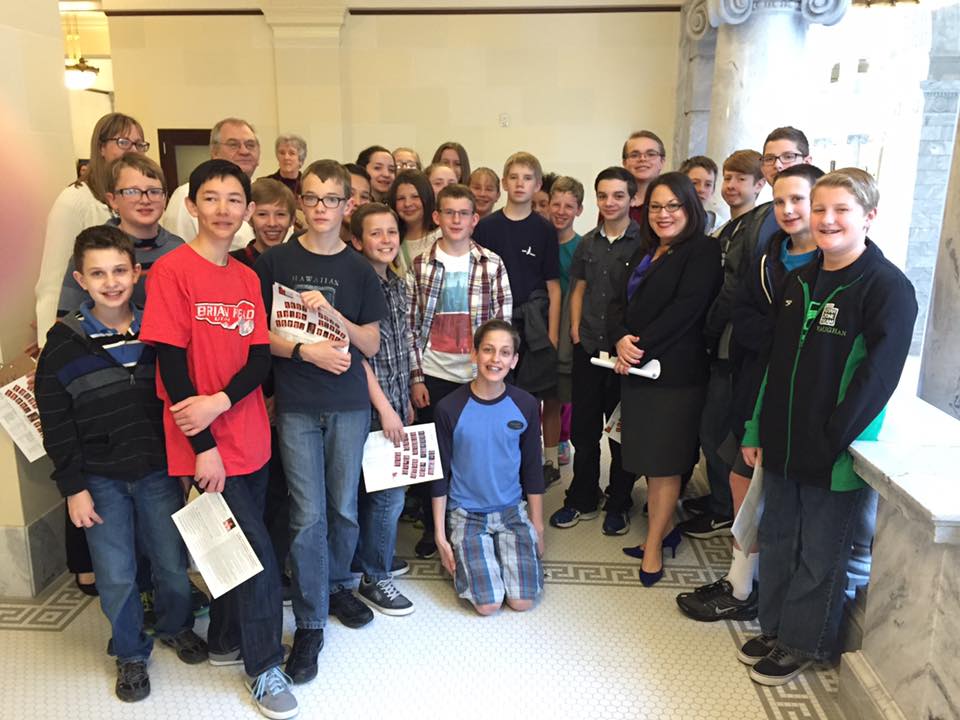
There were a lot of visits from scout troops and school children across the state. One of things I enjoy is talking with the school kids about the legislative process and the importance of being involved in the community. I love seeing the kids enjoy their visit to the Capitol.


Sunday, March 6, 2016

Week Six Review

Capitol Pic of the Day


The 2016 legislative survey results are available and posted here. Take a look and see how the constituents of House District 31 feel about some of the big issues heard during this session.

Medical Marijuana Update:
This Monday, March 7th, HCR 3, SB 73 and SB 89 will be heard in the House Health and Human Services Committee at 10:00 AM in senate building room 210. Click here to listen live at that time.


Medicaid Update:
Representative Dunnigan’s HB 437 Health Care Revisions was heard on the House floor Friday afternoon. It passed out with 55 yes votes, 17 no votes, and three absent. This bill has the support of many in the community, including Mayor McAdams and Mayor Biskupski. This was a compromise bill that will allow the state to help the most vulnerable in need of health care assistance. It captures homeless individuals, childless adults in extreme poverty, people with mental health and substance abuse challenges and it compliments the Justice Reinvestment Initiative in that sense. The bill has a 70/30 match rate (70 federal/30 state), which will allow the state to have more flexibility to customize the plan to Utah's unique needs, compared to if the state matched less than 30 percent. Hospitals will cover a substantial portion of the 30 percent state share.
    
________________________________________________________
SOPHIA'S BILLS (Summary)


HB 289 s1, Charter School Closure Amendments is currently on the senate second reading calendar and should be heard sometime early on Monday. After it passes the third reading calendar, it will be sent to the governor to sign.    
HB 351, Attorney General Fiscal Amendments passed out of the House early in the week and is in the Senate Government Operations and Political Subdivisions Committee. It is on the agenda to be heard on Monday, March 7th at 4:16 PM in Capitol room 415.


HB 397, Department of Administrative Services passed out of the house earlier this week and is in the Senate Revenue and Taxation committee. Click here for more information on the committee.     


SB 56, Nurse Practice Act was heard in the House Education committee on Wednesday (March 2nd). It was heard on the House floor on Friday and passed out unanimously. It is now being sent to the governor for his signature.  

SB 185, Labor Remedy Amendments is a bill that increases damages for discrimination cases in matters of compensation. Increasing the damages in these cases enables the party to be incentivized to keep the case in the state where it can be adjudicated by the Labor Commission, rather than in through federal courts. This provides a more cost effective and more efficient process for both employers and employees. This bill passed out of the Senate and was heard in the House Business and Labor committee on Thursday (March 3rd). It is now on the House third reading calendar and will likely be heard early next week.


_________________________________________________________
CAUCUS UPDATES

Salt Lake County Caucus

Capitol Pic of the Day
The Salt Lake County Caucus heard about transportation-related bills. Below is a brief summary of the issues discussed.

Transportation

1. Unified Transportation Plan 2015-2014: Andrew Gruber (Wasatch Front Regional Council): Utah is among the fastest growing states in the country and is fifth in the nation for growth percentage since 2010. The Unified Transportation Plan takes into account all of this growth and provides a plan for the state. It looks at the demands on our infrastructure including new road and transit projects. Click here to learn more about Utah’s Unified Transportation Plan.  
2. HB 296 - Transportation Funding Revisions: Rep. Anderson: This bill modifies state sales and use tax earmarks for transportation. The Division of Finance would be required to annually transfer a certain amount of revenue from the Transportation Fund to the Transportation Investment Fund. This transfer of funds would allow for more money to be available for future projects. Overall, this bill brings more honesty to where transportation money is going and what it is doing. This bill passed out of the House and is currently in the Senate Transportation and Public Utilities and Technology committee.
3. HB 209 - Public Transit District Board County Amendments: Rep. Anderson, Sen. Shiozawa: This bill amends the membership of the UTA Board of Trustees. Salt Lake County lost some of its population to the unincorporated areas which changes the dynamics of the board. This bill also allows us to look at the UTA governance. Over the next year, there will be a study to look at the board. This bill passed the house and is currently on the senate second reading calendar.     
4. HB 431 - Affordable Housing Revisions: Rep. Edwards: This bill defines affordable housing as housing that meets the needs of those up to 60% of the annual median income. There are joint plans laid out for areas within half a mile of transit stations. For these transit-supportive development projects, the transit district will work with the metropolitan planning organization, city, and county where the project is located. This is a collaborative effort to create joint plans for these areas. This bill is currently on the house third reading calendar.
5. SB 80 - Infrastructure Funding Amendments: Sen. Adams, Rep. Perry: This bill redirects a certain sales and use tax revenue from the Transportation Fund to the Water Infrastructure Restricted Account. If this bill passes, the amount transferred between accounts would be 1/16%. The 1/16% equals about $35.7 million. If this bill passes, it will take effect on July 1, 2016. This bill is currently circled and on the house third reading calendar and will probably be heard soon.            

Land Use

6. HB 318 - Point of the Mountain Development Commission Act: Rep. Wilson, Sen. Stevenson: This bill creates the Point of the Mountain Development Commission, make up of a 15 member commission which would include appointees from the House, Senate, Governor’s Office, and county officials. The commission will evaluate, study, prepare reports so that they can make recommendations about the future planning and development in the point of the mountain area. The commission will only make advisory recommendations and will not have tax or land use authority. This bill passed out of the house and is currently on the senate second reading calendar.
7. HB 360 - Land Use Amendments: Rep. Brown, Sen. Van Tassell: This bill requires counties and municipalities to publish certain land use ordinance information. Specifically, the counties shall give notice if the proposed land use ordinance enacts stricter requirements or higher standards. This bill passed out of the House and is currently on the Senate second reading calendar.

Online Sales Tax

8. SB 182 - Sales and Use Tax Revisions: Sen. Harper, Rep. McKell:  This bill expands on existing law requirements related to internet sales purchases. There are numerous states that have enacted similar bills and many more are currently in the process. The intent of these bills is to assure congress that almost all of the states are on board. This bill passed out of the senate and is now in the house revenue and taxation committee.
9. HB 235 - Remote Transactions Parity Act: Rep. McKell: Under current Utah law, everyone is already required to pay a sales and use tax on all sales (whether brick and mortar or online). If the tax is not paid at the time of purchase, it is to be remitted as part of one’s Utah income tax return. The problem is that few Utahns are doing the latter, leading to an estimated $180 million lost in uncollected sales tax revenues (in this last year alone). This bill would have online retailers calculate the Utah sales tax during the checkout process, and then remit to the state, bringing consumers into compliance with existing state law and creating market fairness. Rep. McKell is proposing to lower the overall sales tax rate so that it would be revenue neutral and not a burden to the taxpayers. If this bill passes, it would have an effective date of January 1, 2017.  This bill is currently circled on the house third reading calendar.     

_________________________________________________________
STANDING COMMITTEES


SB 100, Traffic Fines Amendments, also known as the "Mantua bill," has garnered a lot of attention in the press. It requires cities and towns to remit any speeding ticket revenue that is over 25% of their budget. Any amount exceeding 25% would be redirected to the state's General Fund. The committee voted 7 to 1 to hold the bill and return it to Rules.

To check out some other bills, click on one of the committees below.

House Transportation Standing Committee


_________________________________________________________
APPROPRIATIONS SUBCOMMTTEES


Our House Majority Caucus distributed a budget document that reflected the priorities of each of the appropriation subcommittee chairs. Later, the Executive Appropriations Committee met and distributed the first list (see last list).

Click here for the official February revenue estimates.

Click here for consolidated motions that reflect internal reallocations and intent language for how certain appropriations are to be used.

Click here for the additional one-time and ongoing sources of revenue.

Click here for the long awaited list of items that received funding.

There will be another appropriations bill, called the "Bill of Bills" where bills with fiscal notes get funded, as well as other miscellaneous items that didn't make the first list. I will be sure to post the final list on this blog as well, in an effort to show all of the items that received funding.

________________________________________
OTHER RELATED CAP HAPS 

On Monday, February 29th I met with a small group of undergraduates and graduate students who belong to the American Nuclear Society (ANS) student section. We discussed the role of nuclear science and its future potential. It was great to meet with such bright and engaged students from BYU, USU, and the UofU.

Also on Monday, February 28th, the House paid tribute to families of fallen Utah soldiers. “We are committed to remembering that the preservation of our liberty comes at a price, and that price is often paid by young men and women who selflessly put themselves in harm’s way to protect the lives of innocent people in lands far from home,” a clerk read from the official citation in part. Rep. Fawson, who served in the military and was deployed in Afghanistan and Iraq, said “I wish to comfort those who still mourn, to give light to those whose pathways may be dark, to offer hope to all who look forward to a brighter day, to echo the voice of those who are no longer with us, and to express love.” “As your lawmakers and your representatives, you need to know that we are here and that we are your voice,” said Speaker Hughes.


On Tuesday, March 1st, I had the honor of inviting Pastor Jaime Moreno and Rich Beaudoin to lead the prayer and Pledge of Allegiance on the house floor. Pastor Jaime is a pastor at Mt. Calvary Family Worship Center in West Valley City.

Thursday, March 3rd, was Girl Scouts Day on the Hill. This is one of the representatives favorite themed days because it means endless Girl Scouts cookies in the kitchens. We recognized four young women for receiving the highest Girl Scouts award. In order to earn their Gold Award these young women completed 30 hours of leadership work, 40 hours of career exploration, as well as executing their own project that has a sustainable impact. These women’s projects included making homestay bags for foster kids, starting a youth reading camp for first to fourth graders, starting a ski and snowboard gear donation program, and designing a coloring book to teach children in Central America about dental hygiene. These women are amazing and we were lucky to be able to host them at the Capitol!