Utah Cap Haps Blog

Saturday, November 21, 2015

November Legislative Updates


Capitol Pic of the Day


INTERIM HIGHLIGHTS

Government Operations Interim Committee - The committee listened to five  proposed bills related to election law. One that garnered a lot of attention is a bill that would require the county clerks to release counted votes on a daily basis, after election day, in races where the numbers are too close to determine the highest vote getter. Currently, if a race is too close to determine a winner on election night, the clerks take two weeks to complete a canvass and count all of the absentee and provisional ballots. 

Economic Development and Workforce Services Interim Committee - One of the initiatives this committee is tracking is the Intergenerational Poverty Initiative. This is an impactful initiative that seeks to understand and address poverty at the family level, in an effort to break the cycle of poverty that carries on from generation to generation. Click on this link to see a summary of the key findings and recommendations out of the most recent report

Retirement and Independent Entities Interim Committee - The committee met on November 10th and heard a multitude of proposed legislation related to the current retirement system. The Retirement Working Group presented four bills that resulted from their work. The interim committee (parent committee) passed three of the four bills and stopped short of reversing the mass changes that established the Tier II system.


LEGISLATIVE POLICY SUMMIT

Former budget colleagues now in other policy roles
On November 19th, the Legislature had its second biennial legislative policy summit. Utah has legislated some reputable best practices related to budgeting. For example, if we have revenue above the trend, we require ourselves to treat it as one-time money, rather than ongoing money. The idea is that we should not budget for ongoing needs with volatile revenue that may correct itself in the following year. We also pay down our debt with cash in good times, so that our bond rating can remain high. This allows for us to bond with great rates during the economic down turns, when our cash is on high demand for other critical needs. 

We also learned about why our General Fund dollars are shrinking over time. Our consumption behavior has shifted dramatically, from buying in a tangible market, to a non-tangible, service-based market. Additionally, over time, more of our sales tax(General Fund)revenue has been set aside for various earmarks. 

As local governments take up a larger share of the total state and local tax collections, it will be more difficult for the state to raise rates in the future. 

We also reviewed our demographic changes and trends. While we remain the youngest in the nation, we are gradually getting older. With our aging population, we are going to experience different challenges, including increased issues with housing affordability. 

Going forward, we are seeing that the housing demands by the millennial and the aging population will be for multi-unit, affordable housing. Currently, there isn't enough supply to meet future demand. 

Also, the minority share of the population is growing quickly. In fact, the minority is now the majority in Salt Lake City among current kindergartners. This will certainly change the way we innovate, educate and accommodate this new market. 

We are trending ahead of the nation in terms of wage growth, which will be a positive economic force for the state. We are consistently adding new jobs on an annual basis and have already exceeded the amount of jobs we had prior to the great recession.
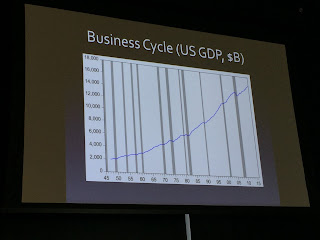
Speaking of recession, the next one is predicted to occur in mid-2017... With our enrollment growth continuing to grow each year,it is important that we set expectations so that we don't end up like we did after the last great recession and unintentionally create volatile funding shifts in education. 


OTHER RELATED CAP HAPS

It was a busy but fun month. I had the opportunity to participate in several panels and speaking engagements for groups including Real Women Run, the Asian and Pacific American Institute for Congressional Studies (APAICS), the Utah Association of Government Accountants(AGA), and the Women's Republican Club of Salt Lake


It's great to be able to share stories with others and be inspired by so many who want to contribute to the greater good. 


Friday, November 20, 2015

State School Board Elections - Election Issue


Utah Supreme Court Ceremonial Chamber

Current State Board of Education
15 members 
No required minimum age
 4 year terms
Elected by the voters of their district (sort of)
Meet 11 times a year to conduct business


1. WHAT IS THE SITUATION?
  • The Utah Supreme Court issued a ruling that tells us that the current process in which we elect state school board members is unconstitutional
  • We have an upcoming election (2016), in which these positions are up for election 
  • We have no constitutional remedy in place
  • On Nov 3, 2015 the Governor announced that he would not assemble the Nominating and Recruiting committee because the courts ruled it unconstitutional

2. HOW DID WE GET HERE?
  • Judge Waddoups’ ruling says our selection process isn’t constitutional because it violates the free speech of the applicants
    • Applicants must censor selves in the interview process in order to get on ballot
    • Voters should determine what that evaluation process should be
  • Current election process   
    • Governor assembles Nominating and Recruiting Committee
      • Assembled by the November 1st before a general election
      • 12 members
      • 2 year term
      • Represents 6 different industry areas
        • Manufacturing and mining
        •  Transportation and public utilities
        • Service, trade and IT
        • Finance, Insurance and real estate
        • Construction
        • Agriculture
      • 6 different education areas
        • Teachers
        • School administrators
        • Parents
        • Local school board members
        • Charter schools
        • Higher education
      • Review Committee advances a minimum of 3 and maximum of 5 candidates per board seat to governor 
      • Governor narrows it down to 2 who get listed on the ballot for voters to decide winner
      •  The only required criteria
        • Candidates possess “outstanding professional qualifications relating to the powers and duties of the State Board of Education,” including experience in:
          • A multitude of business and industry areas
          • Higher education or public education administration
          • Applied technology education
          • Public education instruction
          • Economic Development
          • Other life experiences that would benefit the board
  • 70 people filed for candidacy - 37 candidates were selected by the committee for interviews - a handful of people who didn't advance forward, sued 
  • Ruling says the requirements are too broad
    • Applicants’ free speech rights cannot be subjected to self-censorship because they are fearful that their beliefs and speech will offend the gatekeepers and deny them ballot placement
    • The school board is an elected position, not an appointive position
    • The voters should be the gatekeepers and can apply their own evaluation rules and standards 
  • Judge did not issue a remedy
    • Some candidates who weren't advanced to the Governor for consideration requested that the remedy be to place them on the ballot; but no remedy for the process was put into place

3. HISTORY OF THE ELECTION PROCESS
  • State Board of Education was created by the Utah Constitution, which allows the Legislature to determine election process
    • “Membership of the board shall be established and elected as provided by statute”
  • State initially had non-partisan elections
  •  In 1992, the election process was changed to incorporate regional committees that interviewed and narrowed candidates down to 3-5, who were recommended to Governor. Governor then picked two to be on the ballot.
  • In 2002, the election process changed again, to establish one state committee, rather than regional committees
    • Equally comprised of education representation and business and industry representation

4. PROPOSED SOLUTIONS

2015 General Session proposals:

o   Non-partisan Elections: HB186, State School Board Membership and Election Amendments: Creates a direct nonpartisan election for the state school board, requiring candidates to gather signatures from residents in their area in order to appear on the ballot.

o   Partisan Elections: SB104, Education Elections and Reporting Amendments: Eliminates the nominating committee and requires candidates for state and local school boards to participate in a partisan school board election. 

o   Governor Appointment: HJR16, Proposal to Amend Utah Constitution - Governance of Public Education: Amends the constitution to require that all state school board seats be appointed by the governor and confirmed by the Senate. 


 The House sent over to the Senate HB186, a nonpartisan election bill which was hijacked and inserted with language that made it partisan, before going to the ballot for the public to decide if it should be governor appointed. SJR5 was also sent over in an effort to get it on a ballot for a constitutional amendment. All proposals failed and the 2015 General Session ended with no legislative solution. The Government Operations Interim Committee was assigned the task of developing a viable proposal. 


o   Board shrinks from 15 to 13
§  4 partisan
§  4 non-partisan
§  5 appointed by Gov and confirmed by Senate
o   Seats based on 4 congressional districts
o   Voters in each district gets represented by 1 partisan, 1 non-partisan, and 1 appointed
o   Proposal would go to voters as a proposition on the ballot

The interim proposal did not move forward as a committee bill. 

5. WHAT NOW? REVIEW CURRENT GENERAL PROPOSAL

The most current proposal is to modify the current process so that it is constitutional. This is an option that will at least get us through the next election cycle, while the Legislature reviews and revisits other options.

The Governor must call the Legislature into a special session to address the issue in order to have a process in place for the upcoming election cycle. The ideal time to have a special session would have been during this November interim period (Nov 18-20), since all of the members are in town and it is the last interim of the year (no interim meetings are held in December). There have been talks of convening a special session before the general session, but nothing confirmed at this point in time. 


Friday, October 30, 2015

October Legislative Updates


Capitol Pic of the Day


MEDICAID EXPANSION

Click on this link to get up to speed on the current status of Medicaid Expansion. 

INTERIM HIGHLIGHTS

Elected Officials & Criminal Justice Appropriations Subcommittee The committee meeting took place at the Fortitude Treatment Center, which is a halfway house for male parolees who are working to integrate back into society. The committee heard an overview of an audit on the Attorney General's Office and took action to further explore better alternatives related to billing for services.  

Additionally, the Juvenile Justice Center recently invited the Council of State Governments (CSG) to audit their practices and make recommendations for improvement. Visit this link to see a list of the findings and the agency's response. 

Government Operations Interim Committee - The committee listened to several proposed bills addressing election law. One standardized the way categories are to be listed on the ballot. Another provided options for clerks to notify voters of an election. And another shortened the time frame by which an election officer is required to mail absentee ballots (vote by mail) to voters. 

Additionally, our Legislative Fiscal Analyst demonstrated how to use their newly developed federal funding risk model. It is a dynamic tool that allows you to assess risk associated with the various pots of federal dollars, in the event that certain committed federal dollars are not allocated to the state, due to a shutdown, default or sequestration. Check it out. It is available for the public to use as well.

Economic Development and Workforce Services Interim Committee - The committee spent most of its time listening to annual report presentations from various state agencies. To see what the following agencies worked on during the year, click on the interested report on the "view list" hyperlink under "meeting materials" for the October 21st meeting.

Retirement and Independent Entities Appropriations Committee - The committee heard an update on the consolidated DHRM ISF rates and why it makes sense to have consistencies in all of the agencies with respect to services, regulations and rates. The committee also heard an update on the goals and initiatives for the Utah Futures program, as well as the Education and Telehealth Network's FY 2015 accomplishments.  


OTHER RELATED CAP HAPS 

I had the opportunity to participate in a few events this month. 

The Utah Multicultural Commission hosted their annual youth summit, where I participated on a panel with two other colleagues to talk about civic engagement. Roughly 2,000 at-risk youth gathered at the South Towne Convention Center to participate in the day long conference with various break-out sessions. 

I participated on a panel discussing community engagement pathways for the Utah Compact Engaged Citizen Retreat. 

Participants included AmeriCorp volunteers and undergraduates from colleges all around the State of Utah. It was rewarding to meet so many service-minded people around the state who are committed to making a difference in people's lives.


Medicaid Expansion in a Nutshell


BRIEF BACKGROUND

One of the unintended consequences of the Affordable Care Act (Obamacare) was that it created a coverage gap for people in the State of Utah who make too much money to qualify for Medicaid coverage and not enough money to qualify for tax subsidies to purchase private insurance coverage. 

During the last legislative session, the legislature could not agree on any of the proposed plans to resolve this issue. As a result, the legislature passed a resolution forming a small group that would continue working on a revised proposal. This group was later labeled,  the "Gang of Six" (Governor, Lt. Governor, Senate President, House Speaker, Majority Leader and the primary sponsor of the original proposal). 

The Gang of Six came up with a plan called, Access Plus.


NEW PROPOSAL RE-CAP

The Health Reform Taskforce met on October 6th to review the Utah Access+ plan and associated waiver requests. The committee met for four hours, about an hour longer than scheduled, in order to listen to the constituents and stakeholders who wanted to be heard. Listen to the meeting through this link. You may also view a list of public comments that was provided in writing. 

The plan implemented a cost share in the financing of the plan, where the state would pay one third of the state's share, and the medical providers would pay two thirds. For details, see the actual Utah Access+ Medicaid Expansion Proposal.

The House Majority Caucus largely disapproved of the new proposal, with fewer supporters than for Healthy Utah. Watch the press interview right after the meeting, along with a brief Utah Policy interview that provides a summary of the issues surrounding the new proposal.

The plan failed to garner sufficient support in either the Senate or the House of Representatives. One of the primary arguments to support expansion was that we are paying federal taxes to the federal government and getting nothing in return. With the release of new budget estimates, we recently learned from our Legislative Fiscal Analyst that without expansion, we are getting back even more than we paid out. Below are the recently released numbers.

As mentioned repeatedly by legislative leadership in both the House and Senate, this issue is not likely to go away. Additional forthcoming proposals are anticipated. 

Monday, September 28, 2015

September Legislative Updates


Capitol Pic of the Day

IMPORTANT NOTICE

The details of the new Medicaid proposal established by the "Gang of Six" (Gov. Herbert, Lt. Gov Cox, Speaker Hughes, President Niederhauser, Senator Shiozawa, and  Majority Leader Dunnigan) will be presented to the Health Reform Task Force meeting on October 6th, 3-6pm. Public comment will be heard. Follow along and share with me your feedback. 


INTERIM HIGHLIGHTS

Retirement and Independent Entities Interim Committee - The committee met on Sept. 9th and heard an overview of the retirement contribution rates and upcoming draft legislation (agenda). There is a Retirement Working Group that is also studying the pros and cons of potential modifications of our current post-retirement restrictions. 


Elected Officials & Criminal Justice Appropriations Subcommittee - This committee meets twice during the interim period (in between general sessions). We met on Sept. 22nd, and will meet again next month. For our meeting, we spent a great deal of time discussing issues related to offender treatment and the Criminal Justice Reinvestment Initiative (agenda). We ran out of time for the last agenda item, which will be heard in the next meeting. Listen to the discussion here.


INFORMATIONAL RURAL TOUR 

Huntington Power Plant
Years ago, the legislature used to do an annual informational tour through rural Utah. This year, they started it up again in an effort to see first hand, much of the issues we deal with on the hill but don't get to see or experience outside of the Wasatch Front.

We started with an introduction to the future of coal and power generation in Utah. We learned about the coal industry while passing by the decommissioned Carbon Power Plant, and later visited the new USU Eastern campus building where Lt. Governor Spencer Cox gave an update on the flood tragedies in southern Utah.
Lt.Gov Cox - USU Eastern

About half (47%) of our state's energy production comes from coal and 40% of Utah's energy consumption is from coal, which contributes to keeping our energy prices low in Utah. Coal production is a primary economic contributor to several rural counties in the Castle Country area and the industry requires balanced regulation so that its economic viability isn't harmed.

Six coal mines in the Emery County area have been shut down, resulting in a loss of about 250 jobs. That's quite an impact to a county like Emery where the population hovers just under 11,000 people.

Green River High School 
We then visited Green River High School and learned about the unique challenges facing small rural schools. Attendance isn't monitored too strictly since kids sometimes have to stay home to watch their younger siblings while their parents work. And since there is no hospital or dentist office in the area, it is common to have to miss a whole day for simple doctor appointments.

Some kids are on the bus for an hour and half every day. Tutors often ride the bus with the children to assist with homework during their long drive home. Teachers wear multiple hats and are stretched thin due to the lack of staff.

The Principal of Emery High who is also a county commissioner spoke to us about how the limitations are also opportunities. Every child who wants to participate in a sport is automatically in. There is no need for try-outs since there is always room for players. Teachers get to know the students and their families very well.

During the bus rides to our destinations, we heard from a variety of state and local representatives on the given issues.

In Grand County, tourism has grown to make up the majority of their revenue so there is a growing need to more delicately balance energy extraction opportunities with tourism. We saw examples of how careful consideration is made with respect to where oil and gas wells are placed so that it doesn't detract from the surrounding beauty that attracts so many people from around the world.

Tourists and travelers spent $7.4B in the Utah economy last year which generated over $1B in new state and local taxes. Additionally, over the years, Utah has gained market share over the surrounding states. Consistency in messaging makes a difference and our effective campaigns have proven to be successful.


Sanpete County

On the drive to Sanpete County, we learned about the Narrows Project, a promised dam and reservoir that has a complicated story between Carbon and Sanpete counties going back many generations ago.

We ended with the local Sanpete County elected officials and learned about the challenges and priorities for their county.

We also heard about the positive impacts the current rural programs are having for their areas.

Sanpete County Officials
In all, it was great to learn about these issues at the locations where they are occurring. We were able to understand and take in more than we would from a typical 15-20 minute committee hearing presentation.


OTHER RELATED CAP HAPS


I had the opportunity to attend an exciting announcement that is a perfect example of a successful public-private partnership. The aerospace and advanced composites industry has partnered with higher education to establish a new pilot program called, "Utah Aerospace Pathways." 


High school students in Granite and Davis school districts may earn an Aerospace Manufacturing Certificate through Davis Applied Technology College or Salt Lake Community College and upon graduation, be able to work for one of the great aerospace companies participating in the program, including, Boeing, Janicki, Hexcel, Harris, Hill Air Force Base and Orbital ATK

You can learn more about the program by clicking on one of these links: (uapathways.comFox13News, KUER).


Friday, August 21, 2015

August Legislative Updates - Special Session

Capitol Pic of the Day


SPECIAL SESSION HIGHLIGHTS 

The legislature convened in a special session to consider five issues, including the final decision on the prison site location.

With 62 votes in the House and 22 votes in the Senate, the Legislature voted to support the unanimous bipartisan recommendation of the Prison Relocation Commission (PRC) to move the Prison to the northwest quadrant of Salt Lake City. Read the final bill, HCR101, here.

I voted in favor of moving it to the Salt Lake City site. After carefully evaluating all of the details and options, including keeping it in Draper, I felt that it was the right thing to do for the state, not only in terms of cost, but also in terms of other factors such as re-investments in programs to reduce recidivism, considerations for the employees who have to transport prisoners to locations in SLC, and proximity to volunteers and workforce, vendors, courts, hospitals, etc. The SLC site was the most beneficial and cost affective option in terms of ongoing operational costs.

The SLC site area is far away from residential area and bringing water and roads and other infrastructure will open up industrial opporunities in the area. Our nonpartisan fiscal analyst concluded that moving the prison to the west Salt Lake site would generate $94 million a year in new tax revenues. Under this site option, job creation opportunities for both SLC and Draper are established, which will bring in additional taxes to help pay for the cost of moving it.

Listen to the last meeting of the Prison Relocation Commission (PRC) meeting where all of the options are discussed, here. Listen to the House debate here. Listen to the Senate debate here. All of the reports related to the work of the PRC can be found here and all of the audio of each meeting is posted here.

Other issues on which the legislature took action included eliminating some of the qualifications of the Medicaid Inspector General in order to broaden the pool of applicants, reconsidering a bill that was vetoed by the Governor related to a fiscal fix, clarification on the statute of limitations code, and technical fixes to the Criminal Justice Reinvestment Act that was passed in the last session. Find all of the bills and audio through this link


INTERIM HIGHLIGHTS 

Government Operations Interim Committee - The committee listened to a proposal to redraw the state school board districts to more closely resemble local school district boundaries. The proposal will be revisited later this year.

Additionally, the committee revisited runoff elections and the cost associated with implementing this option in an effort to address the plurality issue. Most of the options come with a hefty price tag. There is still the option to do nothing or to revisit a bill that allowed the parties to choose the ultimate nominee, regardless of who gets the most votes. The committee will continue to study all of the options. 

Economic Development and Workforce Services Interim Committee - The committee heard an overview of efforts to establish affordable housing in transit oriented development areas and reviewed various issues that will come forward in the next legislative session. 

For additional details, visit the committee pages by clicking on the committee headers or the menu to the right of this blog page. 


OTHER RELATED CAP HAPS 

Salt Lake Community College opened up their campus in West Valley City on 3500 South and 5600 West. This campus will be an asset to the district and will open up doors not only for residents in the area, but also for local businesses that are seeking qualified people to join their workforce. It will also serve as an education hub for high school students in the four nearby high schools providing a quality, cost effective education to help them meet their life goals. 


It was great to participate in the Vivante Lives neighborhood party for the National Night Out, sponsored by West Valley City. I enjoyed visiting with the residents in the area.